Guppy Care Guide – The Most Colorful Beginner Fish
Guppy is, quite likely, the most popular fish on the planet, and the first fish for thousands of aquarists around the world. Those colorful tails that look like veils floating in the water, their constant, curious swimming, and the ease with which they adapt to almost any well-maintained tank make them an almost obvious choice for beginners. But “easy” doesn’t mean “careless,” and there are several details that make all the difference between a guppy that merely survives and one that truly thrives, full of color and energy.
The Origin of Guppy
Guppy, scientifically known as Poecilia Reticulata, is native to northern South America and various Caribbean islands, where it lives in streams, ponds, and shallow waters with abundant vegetation. This natural environment explains much of its behavior in captivity: it is an active, curious fish that enjoys constant exploration and feels safest when there are plants and hiding places nearby.
One defining characteristic of Guppy, and one that sets it apart from many other community tank fish, is that it is viviparous. Instead of laying eggs, the female gives birth to fully formed fry that are ready to swim, which makes breeding them in captivity extremely simple. Sometimes even too simple for those who weren’t expecting to see their tank full of fry within a few weeks.
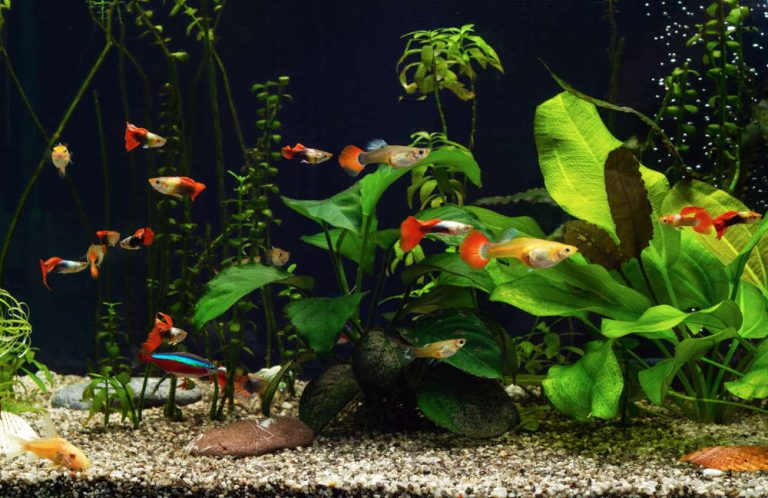
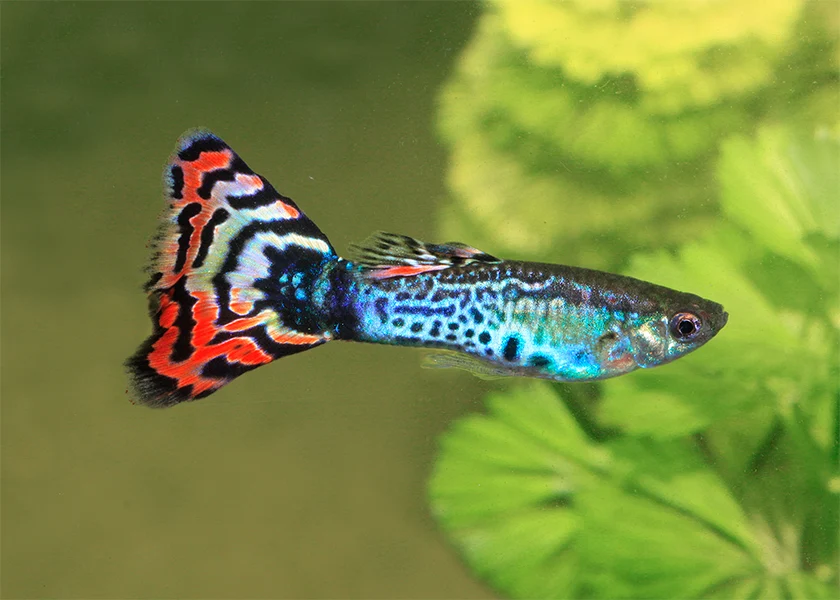
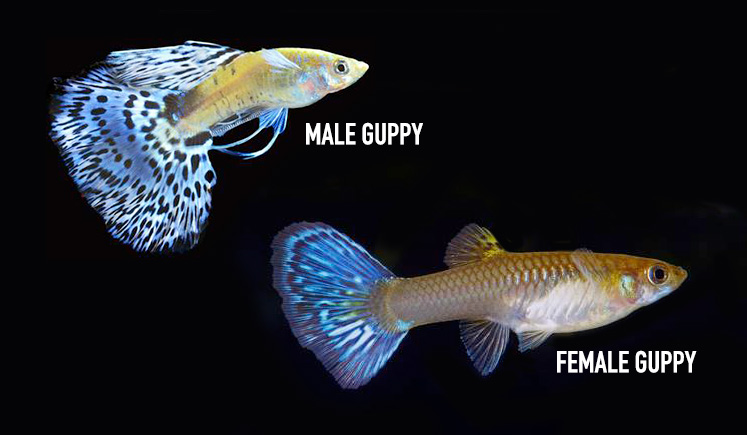
The varieties available today are the result of decades of selective breeding, and range from fan-shaped tails to snake-like or mosaic patterns, in virtually every imaginable color combination. Males are always the most colorful and have the largest tails, while females tend to be larger in body size but much more subdued in color.
Tank Size
Although it is a small fish, the guppy is active and swims constantly, which means it needs space to move around freely. A reasonable minimum for a small group is 20 to 40 liters, although 60 liters or more provides considerably more leeway, both in terms of swimming space and the stability of water parameters.
There’s also a practical reason not to undersize the tank for this particular species: guppies breed with remarkable ease, and a population that starts with six fish can easily double or triple in just a few months if males and females are kept together. Starting with a larger tank gives you some wiggle room for when that happens, rather than forcing you to make hasty decisions down the road.
Water and Temperature Parameters
Guppies prefer water temperatures between 22 and 28 degrees, with the ideal temperature falling somewhere in the middle of that range for most varieties. A thermostat-controlled heater is recommended, especially in homes where the room temperature varies significantly between seasons, since constant fluctuations weaken the immune system and make the fish more susceptible to disease.
As for pH, guppies tolerate a range between 6.8 and 7.8 quite well and adapt without much difficulty to most tap water, provided it is properly treated with a water conditioner. As with any species, stability is far more important than chasing a perfect number: consistent parameters week after week do more for the fish’s health than constant adjustments in search of the ideal value.
Filter and Circulation
Guppies need a filter, just like any other aquarium fish, but there’s one detail worth keeping in mind: the males, with their large, showy tails, struggle more against strong currents than other species with more compact bodies. A filter with adjustable flow is ideal, allowing you to reduce the water output to a comfortable level, especially in smaller tanks where the current is felt throughout the entire space.
If you notice that your Guppies spend a lot of time hiding behind decorations or struggling against the current instead of exploring the tank as they normally would, it’s worth reducing the filter’s power or placing a pre-filter sponge at the outlet to break up the water’s force.
Guppies Diet
Guppies are omnivorous, and a varied diet is key to maintaining their vibrant colors and keeping them healthy in the long term. High-quality flakes specifically formulated for tropical fish serve as a good foundation, regularly supplemented with live or frozen foods such as brine shrimp and daphnia, which make a noticeable difference in the intensity of the fish’s colors and their energy levels.
Blanched vegetables, such as small pieces of zucchini or spinach, are also well tolerated and aid digestion. The most common mistake with this species is overfeeding, which quickly clouds the water and leads to digestive problems: the simple rule is to offer only as much as the fish can eat in two to three minutes, once or twice a day.
Reproduction
Here’s the point that catches virtually every beginner off guard. Guppies reproduce with almost absurd ease, and a female can store sperm from a single mating to produce several broods over the course of several months, even without a male around during that time. Each brood can range from twenty to sixty fry, depending on the female’s size and age, and the fry are born already able to swim and feed on their own.
If you don’t want a population explosion, you have a few options:
- keep an all-male tank, which also has the advantage of concentrating all the color in a single group
- keep an all-female tank
- or accept natural reproduction and let the adults themselves partially control the population, since adult guppies often eat their young when there aren’t enough hiding places.
If, on the other hand, you want to breed guppies on purpose, dense plants or java moss provide the fry with the hiding places they need to survive the first few weeks, which are always the most critical.
Tank Mates
Guppies are peaceful by nature and get along well with most species of a similar temperament. The main concern is to avoid fish known for fin-nipping, since the males long, colorful tails are a tempting target for more aggressive species. More aggressive barbs, certain tetras known for this behavior, and larger, territorial fish should be kept off the list.
Peaceful species of similar size, calm bottom-dwelling fish, and schools that swim in the middle water column with no interest in confrontations are usually safe and visually balanced combinations.
Common Mistakes to Avoid
There are some mistakes that are so common among guppy owners that they deserve special mention.
Assuming that “easy fish” means “low-maintenance fish.”
Guppies are hardy, but they still need cycled water, a proper filter, a heater, and regular partial water changes, just like any other tropical fish.
Completely ignore breeding.
Putting males and females together without any plan to manage the population is a surefire way to end up with an overcrowded tank in just a few months, with all the water quality problems that entails.
Keeping too many males for too few females.
Males chase females almost constantly during courtship, and an unbalanced ratio means the females are under constant stress. The recommended ratio is at least two to three females for every male, to spread out that attention.
Too strong a current in the filter.
As mentioned above, but worth reiterating: large tails and strong currents don’t mix well, and the result is a stressed fish that spends the day hiding instead of exploring the tank.
Buying guppies of dubious origin.
Unfortunately, many guppies sold at large retail stores come from intensive breeding operations with weakened genetics, which results in fish that are more susceptible to disease and have a shorter lifespan. It’s always worth looking for local breeders or reputable specialty stores.
Frequently Asked Questions
How long does a guppy live?
Under good conditions, two to three years on average, although well-cared-for specimens with good genetics may live longer than that.
Can I keep only males in the same tank?
Yes, you can, and it’s a very popular option precisely because it allows you to concentrate all the color in a single group without worrying about breeding. It’s worth ensuring there’s enough space and hiding spots to reduce minor hierarchy conflicts among them.
Why have my guppies lost their color?
The most common causes are stress, poor water quality, unstable temperature, or a diet lacking in variety. It’s worth testing the water and reviewing their diet before assuming they have a disease.
Guppies are fish that really reward those who provide them with the right conditions: a spacious tank, stable and heated water, a filter with gentle water flow, and a varied diet. In return, you get one of the most colorful and lively fish you can have, and a good lesson in how even the easiest fish deserve serious care.