How Often Should You Change the Water of your Tank?
Partial water changes are the most important maintenance task in the entire hobby, and at the same time the most misunderstood by beginners. This guide demystifies everything you need to know: how much to change, how often, and the mistakes that can seriously harm your tank if you’re not careful.
Why is PWC necessary?
Your tank’s filter is excellent at converting toxic ammonia into nitrites and then into nitrates through the nitrogen cycle. What the filter doesn’t do is remove the nitrates that accumulate over time. Only PWC can do that, and without it, nitrate levels rise steadily, causing chronic stress in the fish and paving the way for algae blooms. Parcial Water Changes also replenishes minerals consumed by fish and plants and removes dissolved organic matter that the mechanical filter doesn’t capture.
What is the ideal percentage?
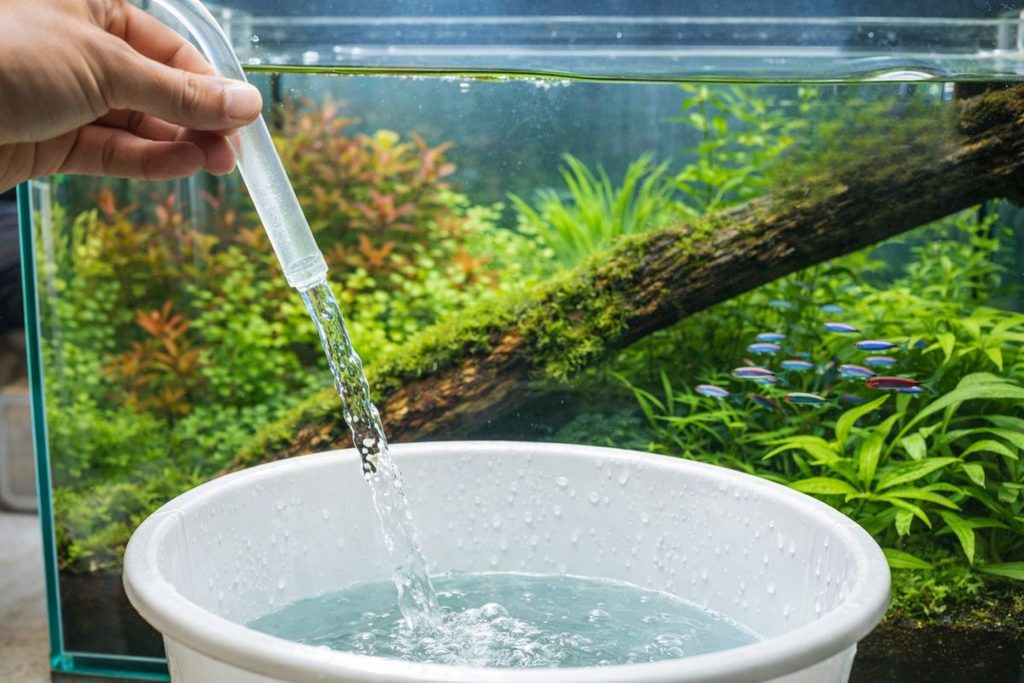
The general recommendation for routine maintenance is between 20% and 30% of the tank’s total volume. This is the ideal range, sufficient to remove a significant portion of the accumulated nitrates without causing sudden changes in the water that could stress the fish. Changing more than half the water at once should be reserved for emergency situations, such as a severe ammonia spike, and not for normal routine maintenance.
Weekly vs. Biweekly Frequency
There is no one-size-fits-all answer for all tanks; it depends on the stocking level, the type of filtration, and the number of live plants. In a community tank with moderate stocking, a weekly water change of 20 to 25% is usually sufficient. If the tank has few fish and plenty of plants, a biweekly water change of 15 to 20% may be perfectly adequate, since the plants help consume some of the nutrients.
Tanks that are overcrowded or contain larger fish may require more frequent water changes, sometimes twice a week. The best way to determine what your tank needs is to test the water regularly, especially for nitrates, and adjust your routine based on the results.
How to Use Chlorine Conditioner
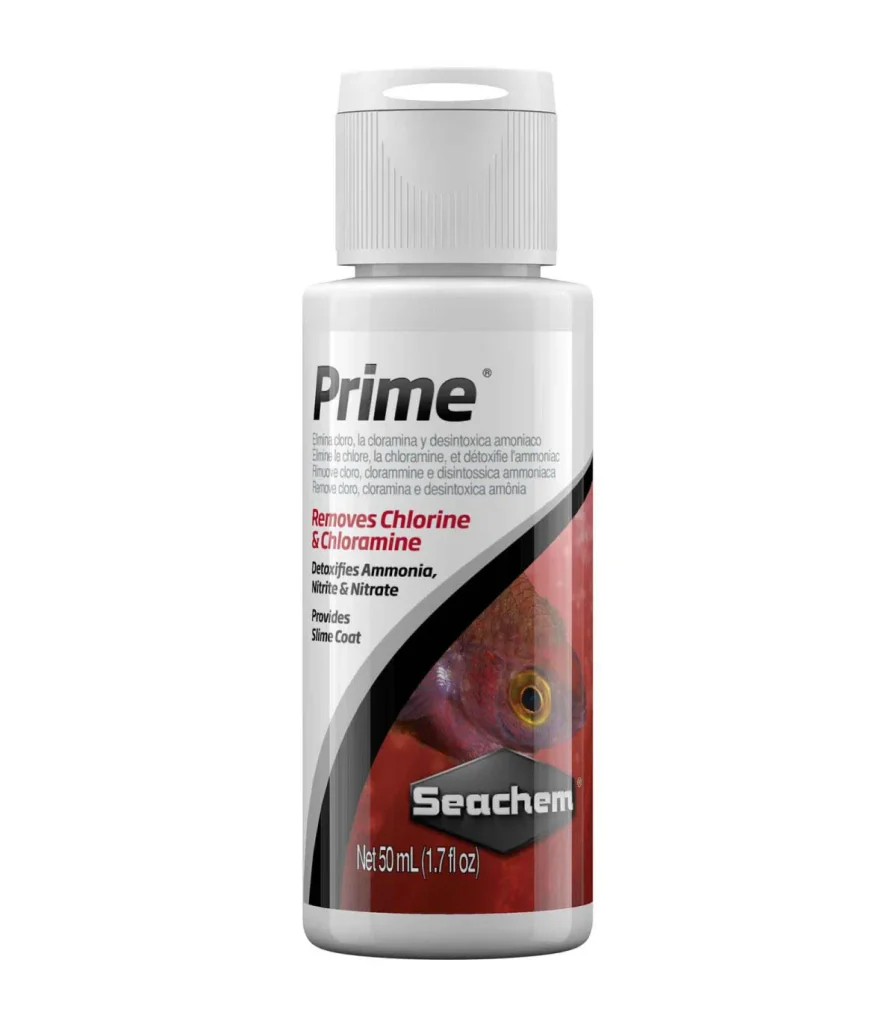
Tap water contains chlorine and chloramine, both of which are toxic to fish and the beneficial bacteria in the filter, so it should never be used directly without treatment. A water conditioner like Seachem Prime is practically indispensable in this routine. Simply add the dose recommended on the package, calculated based on the volume of new water you’ll be adding, and mix thoroughly before the water comes into contact with the tank.
Seachem Prime has an added benefit: it also neutralizes small amounts of ammonia and nitrite, making it useful not only for routine water changes but also in emergency situations where levels of these substances are high.
Step-by-Step Guide to a Well-Done Parcial Water Change
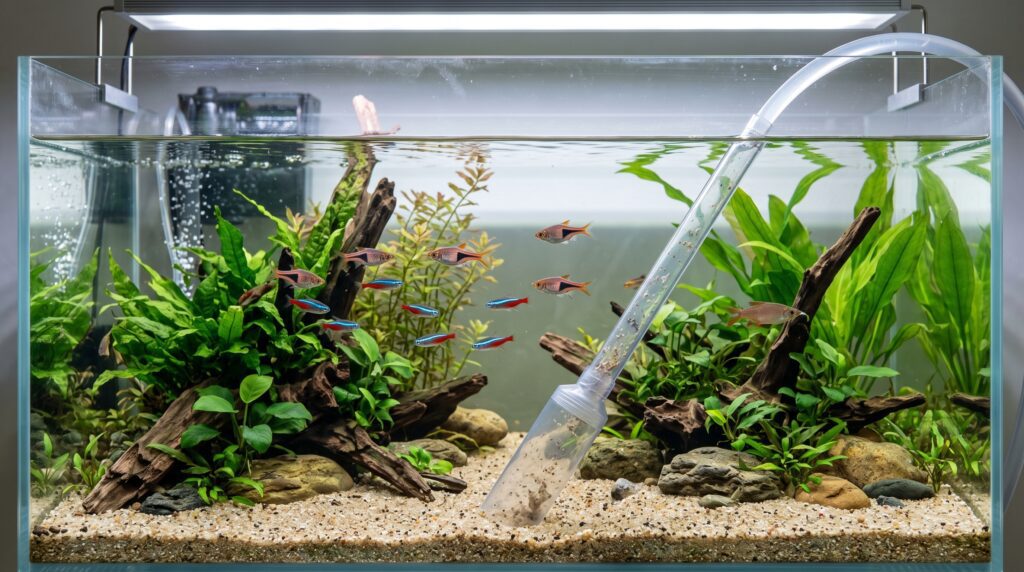
Start by turning off the heater so it isn’t exposed to the air during the process. Also turn off the filter to prevent air from entering the system and causing damage. Use a siphon to suck out the substrate while draining the old water, removing any debris that has accumulated at the bottom. Remove between 20 and 30 percent of the total volume. Prepare the new water with the correct amount of conditioner, and try to bring it to the same temperature as the tank before adding it, to avoid thermal shock. Add the water gradually, without rushing, and only then turn the heater and filter back on.
The Fatal Mistake: washing the filter media in tap water
This is probably the most damaging mistake an aquarist can make without realizing how serious it is. Filter media, sponges, biological ceramic, or any porous material are covered with beneficial bacteria responsible for the nitrogen cycle. Tap water contains chlorine, which kills these bacteria almost instantly.
Washing the filter media under tap water is equivalent to destroying much of your filter’s biological capacity, which can trigger a new ammonia spike similar to that of a newly cycled tank, with all the risks that entails for the fish.
Frequently Asked Questions
Can I take extra PWC?
Within reason, there isn’t much risk, as long as the water is properly treated and at the correct temperature. The problem arises when you combine large water changes with sudden changes in temperature or other parameters.
What happens if I never perform PWC?
Nitrates build up, the fish experience chronic stress, algae take advantage of the situation, and in the medium term, toxic levels can develop, even if the filter is working properly in the rest of the system.
Do I really need a water conditioner, or can I just let the water sit so the chlorine evaporates?
Letting the water sit removes some of the chlorine, but it doesn’t remove chloramine, a more stable compound commonly found in many modern water supply systems, which doesn’t evaporate as easily. A water conditioner like Seachem Prime is the safest and fastest way to ensure the water is free of these substances.
So, we can say that a weekly water change of 20 to 25% is an excellent starting point for most community tanks. Always use a high-quality water conditioner, never rinse the filter media in tap water, and adjust your routine based on what your water tests show over time.
If, after reading this article, you feel that your tank really needs Seachem Prime to protect your fish during water changes, you can check out the product by clicking the button below.