Canister Filter vs. Hang-on-Back vs. Sponge Filter: Which Is the Best Filter for Your Tank?
Choosing a filter should be simple, but all you have to do is visit an online store to be faced with dozens of models, different brands, and promises of “professional filtration.” In practice, the vast majority of tanks use one of three types: the canister (external filter), the hang-on-back (a filter suspended from the back of the tank), and the sponge filter.
Each one has its strengths, weaknesses, and a type of tank where it really shines. In this guide, we’ll take a look at them one by one, compare them side by side, and by the end, you’ll know which one deserves a home in your tank.
What a Filter is Supposed To Do:
No matter the model, a good filter performs three functions. Mechanical filtration traps suspended particles, such as food scraps and debris. Biological filtration supports the beneficial bacteria that convert ammonia into nitrite and then into nitrate, and it is the most important of all because it keeps the nitrogen cycle running.
Optional chemical filtration uses materials such as activated carbon to remove substances dissolved in the water. The main difference between the three filters discussed in this article lies in the amount of work each one can handle and the way it does so.
Canister Filter
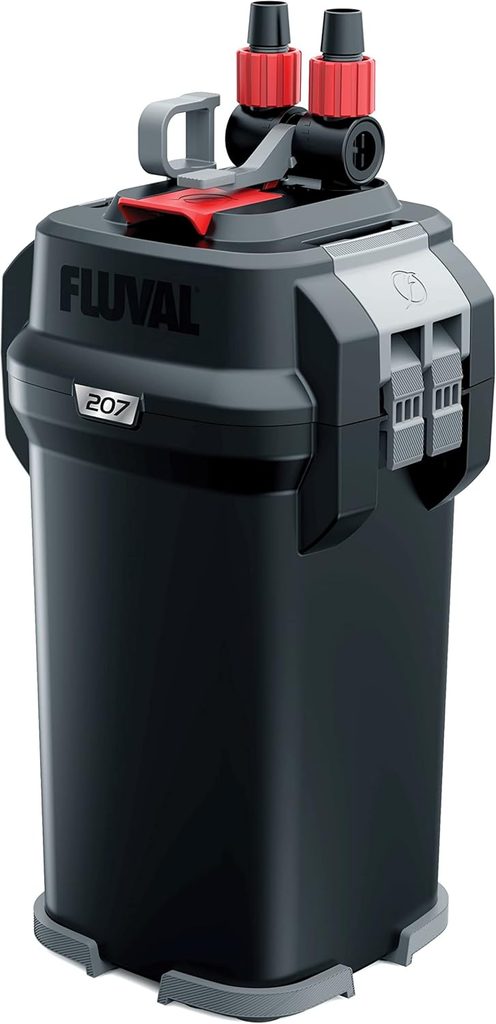
The Canister filter is a sealed container located outside the tank, hidden inside the cabinet. Two hoses connect it to the tank: one draws in the dirty water, and the other returns the clean water after it has passed through several baskets of filter media, driven by an internal pump.
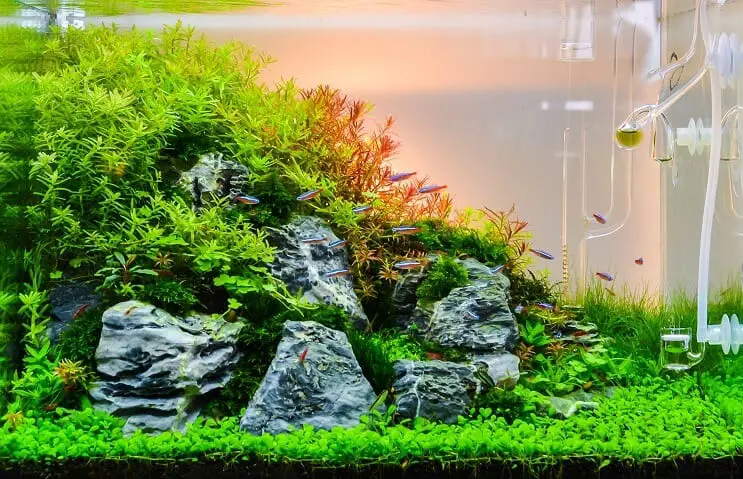
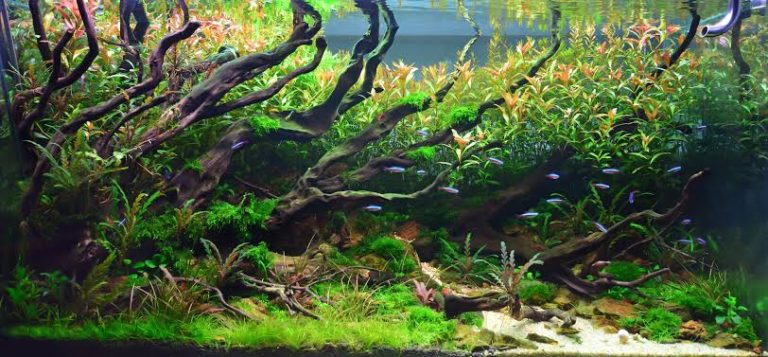
Advantages: It’s the filter with the largest capacity of the three, and this is evident in the amount of filter media it can hold. There’s room for sponges, bio-ceramics, carbon, and resins, arranged in layers of your choosing. Since it’s hidden from view, it keeps the tank visually clean, with no tubes or boxes in sight, making it a favorite for aquascapes. It operates quietly, handles large, heavily stocked tanks, and requires less frequent cleaning: once every one or two months is usually sufficient.
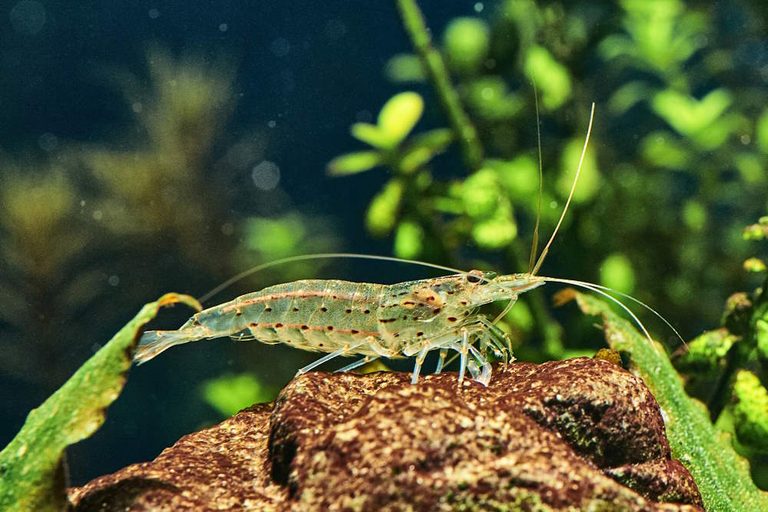
Disadvantages: It’s the most expensive of the three, and installation requires some patience. You’ll have to connect hoses and go through a priming process (filling the filter with water and removing air) before starting it up. Maintenance, although infrequent, is more labor-intensive: you have to turn everything off, disassemble the baskets, clean the parts, and reassemble everything without forgetting any gaskets. A poorly fitted hose can cause leaks inside the unit, so it’s a good idea to check the connections regularly. The water inlet can suck in small fish and shrimp if it isn’t protected, and the strong flow may be too much for fish with long fins, such as Bettas, unless you use a spray bar or another diffuser at the outlet.
Hang-on-Back Filter
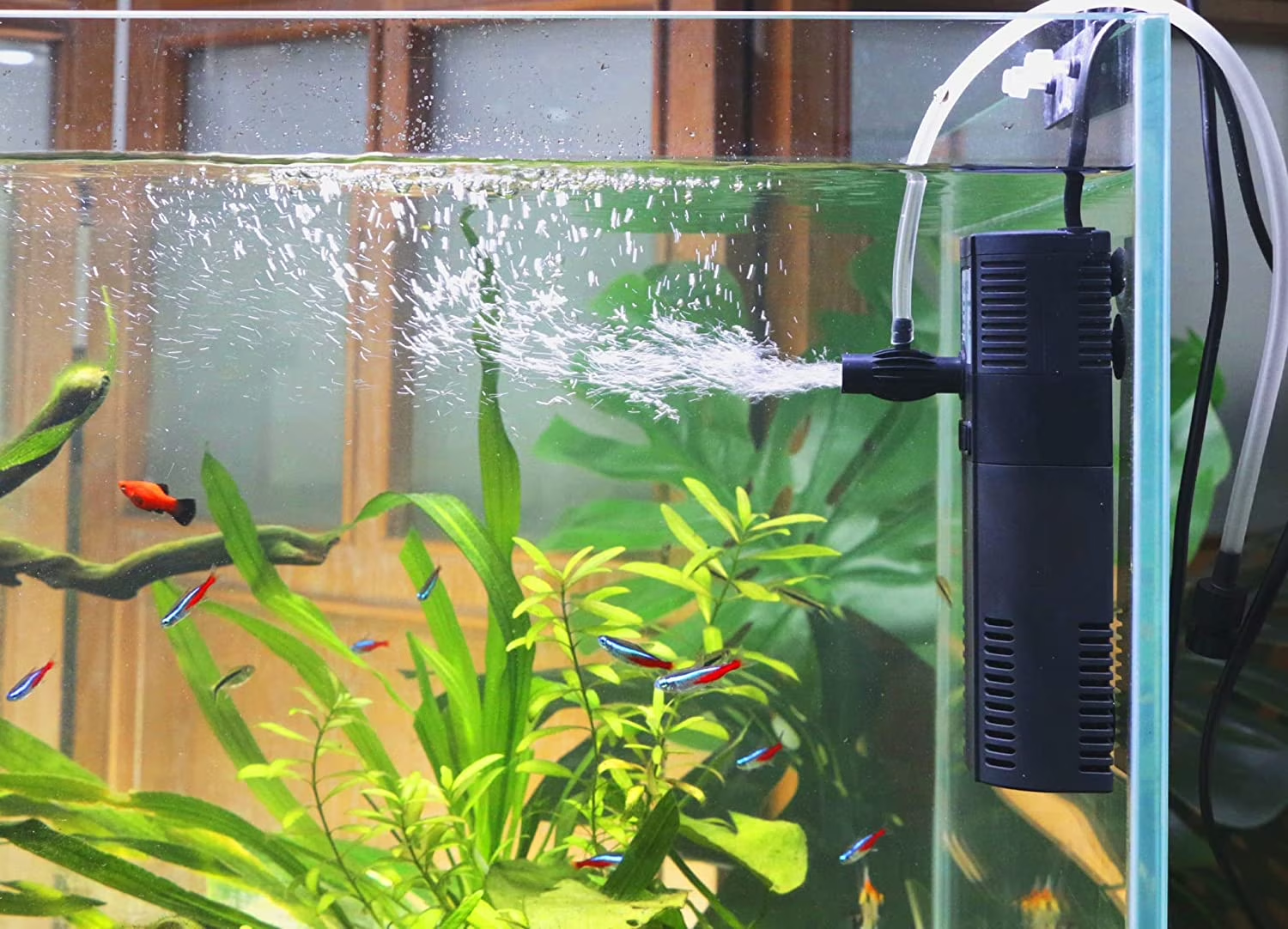
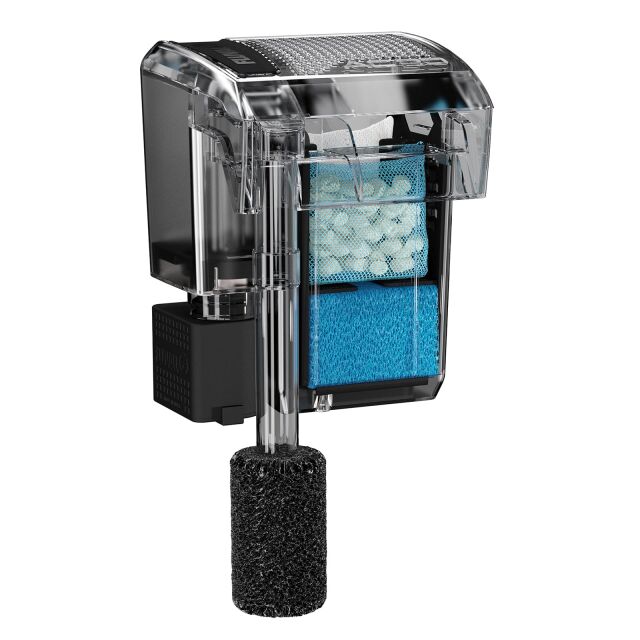
The Hang-on-Back Filter hangs from the back edge of the tank. A tube dips into the water and draws it into a chamber containing the filter media, and the clean water returns to the tank in the form of a small waterfall.
Advantages: It strikes a balance between price and performance. It costs less than a canister filter, installs in minutes (just hang it up, plug it in, and you’re done), and maintenance is simple, with everything within easy reach. It stays out of the water, so it doesn’t take up space in the tank, and the return cascade agitates the surface, which helps oxygenate the water. Many models come with activated carbon cartridges or biological media, providing effortless chemical filtration, and several feature flow control. Just don’t forget: before turning it on, always put a some water in the filter, because otherwise the motor might burn out.
Disadvantages: The noise from the waterfall bothers those who have the tank in their bedroom, and as the water level drops, the noise increases. The intake tube can suck in fry and small shrimp, so the solution is to place a protective sponge over the end. The volume of filter media is smaller than in a canister filter, which limits its capacity in large tanks. There’s also a common pitfall: manufacturers sell “disposable” cartridges, and replacing them entirely discards an entire colony of beneficial bacteria. The trick is to rinse the cartridge with water from the tank itself and replace only part of the media at a time. Finally, agitating the surface causes CO2 to escape, which is a problem in planted tanks with CO2 injection.
Sponge Filter
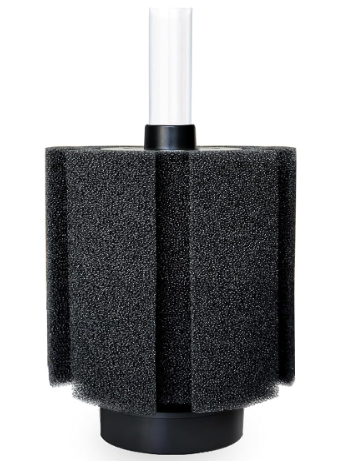
The Sponge Filter is the simplest of the three. A thick sponge, shaped like a cylinder, with a hollow tube in the center, is placed inside the tank and connected by a hose to an air pump. The bubbles rise through the tube, creating a gentle suction that forces the water to pass through the sponge, where debris is trapped and beneficial bacteria live.
Advantages: The main advantage is safety: the flow is so gentle that there’s no risk of sucking in small fish, fry, or shrimp, making it the natural choice for shrimp tanks, breeding tanks, and tanks for long-finned fish. The sponge provides a vast habitat for bacteria, so biological filtration is excellent for the size of the filter. It’s inexpensive, easy to clean (just squeeze the sponge into a bucket of tank water), and has no impeller or motor submerged in the water, so there are fewer parts that can break down. It oxygenates the water with bubbles and restarts automatically when power is restored after an outage, without needing to be primed.
Disadvantages: The main issue is its power: the sponge filter is weak and can’t handle large or heavily stocked tanks. Mechanical filtration is limited (fine particles will get through), and there’s no chemical filtration. It takes up space inside the tank and is visible, with the sponge, tube, and air hose. You need a separate air pump, which costs extra, takes up a power outlet, and can be noisy. The bubbles also disturb the surface, which some fish find hard to tolerate, although a regulating valve solves the problem in most cases.
Side-by-side Comparison
| Aspects | Canister | Hang-on-Back | Sponge |
| Initial Cost | High | Moderate | Low |
| Filtration Power | High | Medium | Low |
| Recommended Tank Size | 80L+ | 20L-60L | 10L-40L |
| Risk of Sucking in Small Fish and Shrimp | Medium (use a guard on the inlet) | Medium (use a guard on the inlet) | None |
| Chemical/Biological Filtration | Yes, with plenty of space | Yes, limited | No |
| Installation | Complex | Simple | Simple (requires an air pump) |
| Maintenance | Less frequent, more labor-intensive | Frequent, simple | Frequent, very simple |
| Noise | Low | Medium (waterfall) | Medium to High (air pump) |
| Visibility in the tank | Hidden | Outside the tank, at the back | Inside the tank |
| Ideal for: | Large, planted tanks | Small to medium community tanks | Bettas, shrimp, fry, and quarantine tanks |
Which one to choose
The best way to decide is to think about what’s in your tank. If you have a small tank with a betta, shrimp, or fry, a sponge filter is the safest choice: the flow is gentle, nothing gets sucked in, and the biological filtration does the job a tank of that size needs. If you have a medium-sized community tank and a moderate budget, hang-on-back filter offers the best balance between price, ease of use, and performance. And if your tank is large, heavily stocked, or an aquascape where you don’t want equipment in plain sight, the canister filter is worth the investment for its capacity and discretion.
You can combine them
Experienced aquarists often use two filters in the same tank, and the most popular combination is a canister or hang-on-back filter as the main filter, plus a sponge filter as a backup.
The sponge acts as a backup: if the main filter fails, or if you give it a thorough cleaning, the bacteria living in the sponge continue to work, and the nitrogen cycle isn’t disrupted. It also lets you set up a quarantine tank in seconds. All you have to do is move a mature sponge from the main tank to the new one.
Frequently Asked Questions
Is a sponge filter suitable for large tanks?
It’s not the ideal choice. It can serve as a biological filter, but as a primary filter, it falls short in large or heavily stocked tanks.
Do I need an air pump for the sponge filter?
Yes. The pump creates the bubbles that move the water through the sponge. Choose one with enough power for the size of the filter and, if possible, one with a valve to regulate the flow.
Can I use two filters in the same tank?
Yes, you can, and in large tanks it’s a common practice. Two filters provide more capacity and a safety net in case one of them breaks down.
How often should I clean each filter?
Sponge filters and hang-on-back filters should be cleaned every two weeks, and canister filters every one to two months. In all cases, rinse the filter media with water taken from the tank and avoid using tap water to preserve the beneficial bacteria.
In short, there’s no such thing as a perfect filter for every tank—there’s just the right filter for yours. The sponge filter excels in safety, the hang-on-back filter in balance, and the canister filter in capacity. Choose the one that suits the size of your tank and its inhabitants, and the water will thank you.
To help you choose the ideal match for your setup without any hassle, here are our top filter recommendations for each category:
| Sponge Filter | Hang-on-Back Filter | Canister Filter |
| A gentle, highly effective solution designed for small setups that require low flow and strong biological filtration. | The best choice for medium community tanks that need maximum filter media capacity and fast, effortless maintenance. | Built for larger planted tanks, multi-stage filtration power while keeping noise levels virtually silent. |